
High-efficiency turret punching for holes, cutouts, and formed features—ideal for repeat orders and cost-effective production
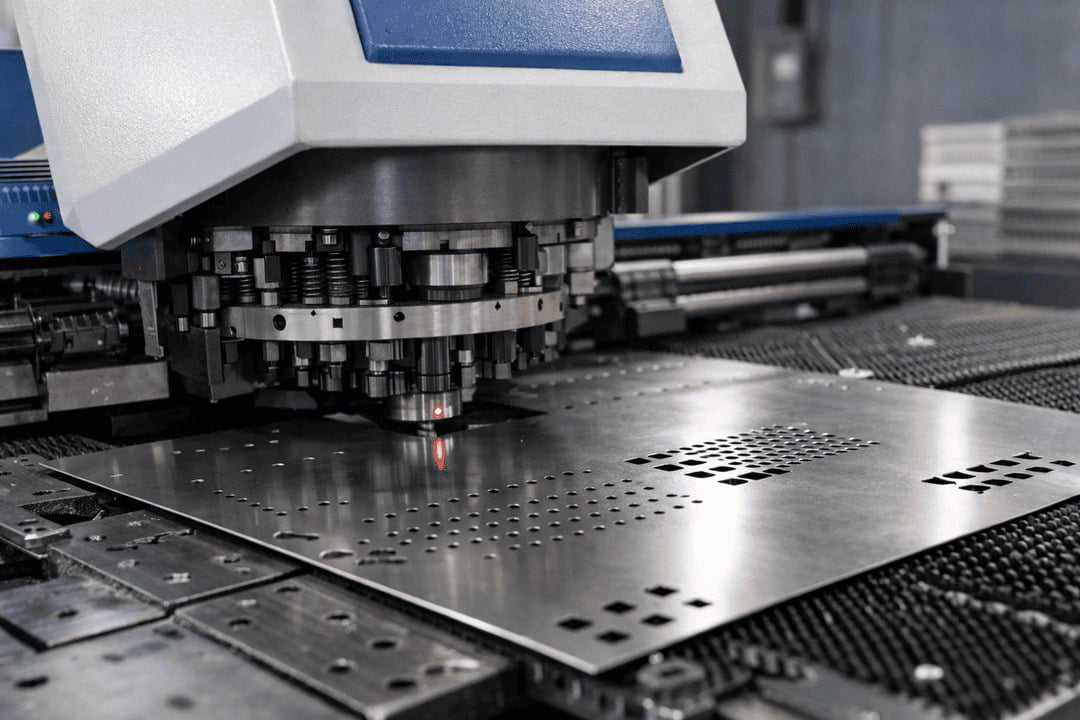
Capability Highlights
Fast cycle time for repeatable parts and high-volume hole patterns
Stable feature repeatability with consistent tooling
Option to create formed features (e.g., louvers/emboss) when applicable
Optimized for cost control vs. cutting-only routes
Works well as part of an integrated cut–bend–finish workflow
Standard vs Extended Capability
Standard: punching for common holes/slots and repeat patterns using standard tooling.
Extended: formed features, special shapes, or non-standard requirements supported on request, dependent on tooling and design—handled per drawing.
Design Notes & DFM Tips
Use standard hole sizes where possible to reduce cost and lead time
Avoid extremely tight spacing between holes/features to reduce distortion
Clearly mark the cosmetic face for parts with visible surfaces
Provide flat pattern DXF with clear dimensions and tolerances
For formed features, specify direction/orientation and functional intent
Quality & Inspection
Inspection per drawing requirements
Reports available upon request (FAI/COC, etc.)
RFQ Checklist
DXF/DWG + PDF, or STEP + PDF
Material & thickness
Quantity and repeat order expectations
Notes on formed features (louvers/emboss), if needed
Cosmetic surfaces & critical tolerances
Finishing requirements
FAQ
Q: Can you do louvers or embossing?
A: Possible on request, depending on tooling and part geometry.
Q: Should I choose punching or laser cutting?
A: It depends on quantity, feature density, and design—send drawings and we’ll recommend the best route.
Q: Can you support repeat production?
A: Yes—punching is well-suited for stable repeat orders.
Q: What’s the best file format?
A: DXF/DWG for flat patterns plus a dimensioned PDF.