6061-T6 is one of the most widely used heat-treatable aluminum alloys in industrial manufacturing. It offers a practical combination of strength, corrosion resistance, machinability, weldability and surface-finishing performance.
From automation frames and semiconductor equipment components to electronic housings and structural brackets, 6061-T6 is frequently selected when a part needs to be lightweight but stronger and more dimensionally stable than general-purpose sheet aluminum.
However, specifying the right alloy is only the first step. The final performance of a 6061-T6 component also depends on how it is machined, bent, welded and finished.
This guide explains the properties of 6061-T6 aluminum, its common applications and the fabrication considerations engineers should evaluate before production.
What Is 6061-T6 Aluminum?
6061 is a precipitation-hardened aluminum alloy containing magnesium and silicon as its primary alloying elements. These elements form magnesium silicide, allowing the alloy to gain strength through controlled heat treatment.
The designation “T6” describes the temper condition:
- T means the material has been thermally treated.
- 6 means it has been solution heat-treated and then artificially aged.
This heat-treatment process significantly increases the strength and hardness of the aluminum compared with softer tempers such as 6061-O or 6061-T4.
The Aluminum Association describes 6xxx-series aluminum alloys as heat-treatable, formable, weldable and corrosion-resistant. Within this family, 6061 is one of the most widely used alloys for structural and industrial applications. The Aluminum Association
Typical Properties of 6061-T6 Aluminum
The exact mechanical properties of 6061-T6 vary depending on product form, material thickness and applicable specification. Typical reference values include:
| Property | Typical value |
|---|---|
| Density | 2.70 g/cm³ |
| Ultimate tensile strength | Approximately 310 MPa |
| Yield strength | Approximately 276 MPa |
| Elastic modulus | Approximately 69 GPa |
| Brinell hardness | Approximately 95 HB |
| Thermal conductivity | Approximately 167 W/m·K |
| Melting range | Approximately 582–652°C |
These values should be treated as general engineering references. For production parts, the applicable material standard and mill certificate should always be reviewed.
6061-T6 is especially attractive because it provides substantially higher strength than many common sheet aluminum grades while retaining relatively low weight.
Key Advantages of 6061-T6 Aluminum
1. High Strength-to-Weight Ratio
6061-T6 provides useful structural strength at roughly one-third the density of steel. This makes it suitable for equipment frames, robotic systems, aerospace-related fixtures and other assemblies where reducing weight improves movement, installation or energy efficiency.
2. Excellent Machinability
6061-T6 is one of the most popular aluminum alloys for CNC machining. Its hardness helps it produce stable dimensions and relatively clean chips during milling, turning, drilling and tapping.
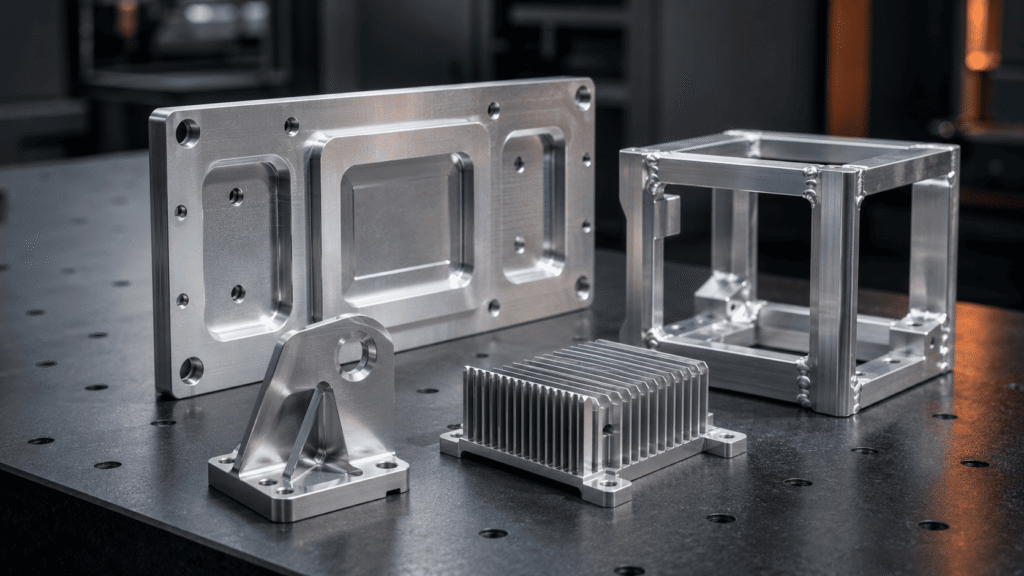
Typical CNC-machined 6061-T6 components include:
- Equipment mounting plates
- Precision brackets
- Valve and manifold bodies
- Semiconductor equipment components
- Heat-sink bases
- Sensor housings
- Robotic end-effectors
- Jigs and fixtures
Appropriate cutting tools, chip evacuation, coolant strategy and machining parameters remain important for controlling burrs and maintaining surface quality.
3. Good Corrosion Resistance
6061-T6 naturally forms a protective oxide layer that provides good resistance to atmospheric corrosion. Additional finishing can improve its appearance, wear resistance and environmental durability.
Common finishes include:
- Clear anodizing
- Black anodizing
- Color anodizing
- Hard-coat anodizing
- Chemical conversion coating
- Powder coating
- Painting
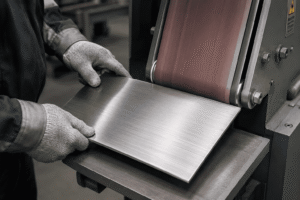
- Brushing and polishing
6061 generally responds well to anodizing and can achieve a clean, professional appearance for industrial equipment and visible components. Hydro
4. Good Weldability
6061 can be joined using TIG, MIG and other suitable aluminum-welding processes. However, welding introduces an important engineering issue: heat can reduce the T6 temper strength in and around the heat-affected zone.
This does not mean 6061-T6 cannot be welded. It means the assembly must be designed using realistic as-welded properties rather than assuming the entire component retains its original T6 strength.
5. Broad Material Availability
6061 is available in multiple product forms, including:
- Sheet
- Plate
- Bar
- Tube
- Pipe
- Extruded profiles
- Custom extrusions
This makes it easier to combine laser-cut sheet, machined plate and extruded structural sections within the same assembly.
Is 6061-T6 Suitable for Sheet Metal Bending?
6061-T6 can be bent, but it is less formable than softer aluminum tempers. Because the T6 condition has relatively high strength and lower ductility, tight bend radii can cause surface cracking or complete fracture.
Several factors affect bending performance:
- Material thickness
- Inside bend radius
- Grain direction
- Bend angle
- Tooling selection
- Edge condition
- Distance between holes and bend lines
For parts requiring tight or repeated bends, 5052-H32 is often a better sheet metal choice. Another option is to form 6061 in a softer temper and complete the required heat treatment afterward, although this adds cost and process complexity.
A DFM review should therefore determine whether the part truly requires 6061-T6 strength or whether a more formable alloy can meet the functional requirements.
What Happens When 6061-T6 Is Welded?
The concentrated heat generated during welding changes the material condition near the weld. The weld and heat-affected zone may no longer retain the full mechanical properties of the original T6 base material.
Hydro notes that 6061-T6 is weldable, but weld strength can be reduced and may require subsequent heat treatment and artificial aging when full strength must be restored. Hydro
Important welding considerations include:
- Joint design and load direction
- Heat input control
- Welding sequence
- Fixture design
- Distortion allowance
- Filler-metal selection
- Surface and oxide removal
- Post-weld machining
- Post-weld heat treatment, when required
Common filler alloys include 4043 and 5356. The correct choice depends on strength requirements, appearance, service conditions, anodizing expectations and the risk of cracking.
For precision welded assemblies, the engineering drawing should identify whether tolerances apply before or after welding and whether critical surfaces will be finish-machined after welding.
Laser Cutting 6061-T6 Aluminum
6061-T6 sheet and plate can be cut using modern fiber laser systems. However, aluminum’s reflectivity and high thermal conductivity require appropriate machine settings and process control.
Production considerations include:
- Material thickness
- Assist-gas selection
- Cutting speed
- Piercing strategy
- Heat accumulation
- Burr requirements
- Protective film
- Edge quality required for subsequent welding
For precision parts, laser cutting is often followed by deburring, CNC machining, bending or surface finishing.
Where very tight hole tolerances or critical interfaces are required, it may be more reliable to laser-cut a pilot feature and finish it through CNC machining.
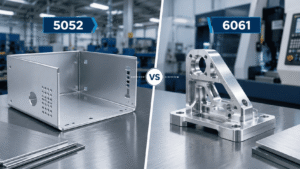
6061-T6 vs. 5052-H32 Aluminum
6061-T6 and 5052-H32 are both commonly used in custom metal fabrication, but they are not interchangeable.
| Consideration | 6061-T6 | 5052-H32 |
|---|---|---|
| Strength | Higher | Moderate |
| CNC machinability | Excellent | Fair to good |
| Tight-radius bending | Limited | Excellent |
| Weldability | Good, with HAZ strength reduction | Excellent |
| Corrosion resistance | Good | Excellent, especially in marine environments |
| Anodizing appearance | Generally good | Good |
| Typical use | Machined and structural parts | Bent and welded sheet metal parts |
Choose 6061-T6 when the component requires higher strength, dimensional stability, machining accuracy or structural rigidity.
Choose 5052-H32 when the design requires tight bends, deep forming or extensive welded sheet metal construction.
In many assemblies, the best solution is not choosing only one alloy. A manufacturer may use 6061-T6 for machined mounting plates and 5052-H32 for the surrounding bent enclosure.
Common Applications of 6061-T6
6061-T6 is commonly used for:
- Industrial automation frames
- Semiconductor equipment components
- Electronic and optical equipment housings
- EV charging equipment
- Battery and power-system components
- Medical-equipment structures
- Robotic assemblies
- Aerospace fixtures
- Telecom equipment
- Machine guards and mounting systems
- Precision jigs and inspection fixtures
- Heat-management components
Its combination of strength, low weight and machinability makes it especially useful for low-volume and high-mix custom manufacturing.
Design Tips for 6061-T6 Parts
Before releasing a 6061-T6 part for production, engineers should consider the following:
Avoid unnecessarily tight bend radii
Increasing the inside bend radius can significantly reduce the risk of cracking.
Identify critical surfaces
Mark datum surfaces, sealing faces, threaded features and precision interfaces clearly on the drawing.
Account for welded-zone strength
Do not calculate the strength of a welded assembly using only the original T6 base-metal properties.
Allow for post-weld machining
Precision interfaces may need to be machined after welding to compensate for distortion.
Specify cosmetic requirements
Define whether scratches, machining marks, welding discoloration or anodizing color variation are acceptable.
Confirm the material form
6061-T6 sheet, plate, bar and extrusion may have different mechanical-property requirements and dimensional tolerances.
Match tolerances to function
Applying extremely tight tolerances to every feature increases machining time, inspection requirements and production cost without necessarily improving performance.
How Meida Supports Custom 6061-T6 Components
At Meida Sheet Metal, we manufacture custom aluminum components from prototypes to production quantities.
Our capabilities include:
- Fiber laser cutting
- CNC machining
- Precision bending
- TIG and laser welding
- Deburring and surface preparation
- Anodizing and powder-coating coordination
- PEM hardware installation
- Assembly
- Dimensional inspection
- DFM support
We review material selection, bending feasibility, weld location, machining allowances and surface-finishing requirements before production. This helps reduce cracking, distortion, tolerance conflicts and unnecessary manufacturing cost.
Frequently Asked Questions
Is 6061-T6 stronger than 5052 aluminum?
Yes. In the commonly supplied T6 condition, 6061 generally provides higher yield and tensile strength than 5052-H32. However, 5052-H32 provides better formability and is usually more suitable for complex bent sheet metal parts.
Can 6061-T6 be welded?
Yes. 6061-T6 is weldable, but welding reduces strength in the heat-affected zone. The assembly should be designed using appropriate as-welded properties or receive post-weld heat treatment when required.
Is 6061-T6 easy to machine?
Yes. It is widely regarded as one of the most machinable general-purpose aluminum alloys and is commonly used for precision CNC-milled and turned components.
Can 6061-T6 be anodized?
Yes. 6061-T6 generally responds well to clear, colored and hard-coat anodizing. Final appearance can be affected by material lot, surface preparation, machining marks and welded areas.
Is 6061-T6 suitable for tight bending?
It is not the best choice for tight-radius bending. Larger bend radii, appropriate grain orientation or a softer temper may be required. For complex sheet metal forming, 5052-H32 is often preferred.
Conclusion
6061-T6 is a strong and versatile aluminum alloy for precision machining, structural components and industrial equipment. Its performance, however, depends on more than the material designation alone.
Bend radius, grain direction, welding heat input, post-weld strength, machining sequence and surface-finishing requirements should all be considered during the design stage.
Need help evaluating a 6061-T6 component?
Send your drawings to Meida Sheet Metal for a DFM review and manufacturing quotation. We support custom prototypes, low-volume production and repeat orders for international industrial customers.