Surface finishing plays an important role in modern sheet metal fabrication. A well-finished metal surface not only improves the appearance of a product, but also enhances its perceived quality, usability and market value. Among many surface treatment methods, such as powder coating, painting, electroplating, anodizing and polishing, sheet metal brushing finish is one of the most widely used options for stainless steel, aluminum and decorative metal parts.
A brushing finish is created by using abrasive belts, sanding wheels, nylon wheels, Scotch-Brite pads or wire brushes to create fine, directional or decorative lines on the metal surface. The result is a clean, uniform and elegant texture that reduces glare, hides minor scratches and gives the product a premium metallic appearance.
Brushed sheet metal is commonly used in machine enclosures, electrical cabinets, control panels, stainless steel covers, aluminum panels, elevator panels, kitchen equipment, medical devices, display fixtures and architectural decoration.
In this article, we will explain what sheet metal brushing is, the common types of brushed finishes, suitable materials, processing methods, applications and key quality control points.
What Is Sheet Metal Brushing Finish?
Sheet metal brushing finish is a mechanical surface treatment process that creates fine lines or grain patterns on the surface of metal parts. Unlike mirror polishing, which produces a shiny reflective surface, brushing creates a matte or semi-matte texture with visible grain direction.
The brushing process can be applied to flat sheets, formed sheet metal parts, welded assemblies and decorative panels. Depending on the required appearance, the brushed texture can be straight, short, random, circular, cross-patterned or satin-like.
The main purposes of sheet metal brushing include:
Improving the visual appearance of metal parts.
Reducing surface reflection and glare.
Creating a uniform decorative texture.
Covering minor scratches or surface imperfections.
Enhancing the premium metallic feel of the product.
Preparing the surface for further treatment, such as anodizing or anti-fingerprint coating.
For many stainless steel and aluminum products, brushing is not only a finishing step but also an important part of the product design.
Common Materials for Brushed Sheet Metal
1. Brushed Stainless Steel
Stainless steel is one of the most common materials for brushing finish. Grades such as 201, 304 and 316 stainless steel are widely used in sheet metal fabrication. Brushed stainless steel has a clean, modern and professional appearance, making it suitable for industrial, commercial and decorative applications.
Common products include:
Electrical cabinets.
Machine covers.
Elevator panels.
Kitchen equipment.
Control panels.
Medical device housings.
Stainless steel doors.
Architectural decorative panels.
The most common finishes for stainless steel sheet metal are hairline finish, No.4 finish and satin finish.
2. Brushed Aluminum Sheet Metal
Aluminum is another popular material for brushing. Brushed aluminum sheet metal is often used for electronic housings, nameplates, equipment panels, control panels and decorative parts.
A common process is:
Aluminum brushing → Anodizing → Coloring → Sealing
This process keeps the brushed metal texture visible while improving corrosion resistance, wear resistance and color stability.
Brushed aluminum is lightweight, attractive and suitable for products that require both appearance and functionality.
3. Brushed Copper and Brass
Copper and brass can also be brushed to create a warm, high-end decorative effect. These materials are often used in signage, interior decoration, art panels, luxury fixtures and custom architectural products.
Because copper and brass are softer than stainless steel, the brushing pressure and abrasive selection must be carefully controlled to avoid deep scratches or uneven grain.
4. Carbon Steel and Cold Rolled Steel
Carbon steel and cold rolled steel can be brushed, but they are less commonly used as exposed brushed surfaces because they are more prone to rust. In most cases, brushing is used as a preparation step before painting, powder coating, electroplating or other surface treatments.
For final decorative parts, stainless steel and aluminum are usually better choices.
Common Types of Sheet Metal Brushing Finishes
1. Hairline Brushing Finish
Hairline brushing is one of the most popular surface finishes in sheet metal fabrication. It produces long, continuous and straight lines in one direction. The texture is fine, clean and elegant.
Hairline finish is commonly used for:
Stainless steel panels.
Machine enclosures.
Electrical cabinets.
Control panels.
Elevator interiors.
Decorative metal sheets.
High-end equipment housings.
The key to a good hairline finish is consistency. The grain direction must be uniform, especially when multiple panels are assembled together. If one panel has vertical grain and another has horizontal grain, the final product may look inconsistent and unprofessional.
For this reason, the brushing direction should always be clearly marked on the drawing or production instruction.
2. No.4 Brushed Finish
No.4 finish is a common brushed stainless steel finish. It has a shorter and slightly more diffuse linear grain compared with hairline finish. It is widely used in kitchen equipment, food processing equipment, appliance panels and architectural products.
No.4 finish provides a practical balance between appearance, cost and durability. It is decorative but not overly reflective, and it can hide minor scratches better than a polished surface.
This finish is especially common for stainless steel products that need a clean and functional appearance.
3. Satin Brushing Finish
Satin finish creates a soft, smooth and low-gloss surface. It is often produced using fine abrasive belts, nylon wheels or non-woven abrasive pads.
Compared with a coarse brushed finish, satin finish looks more refined and gentle. It is suitable for products that require a premium touch and understated appearance.
Typical applications include:
Medical equipment housings.
Laboratory equipment.
High-end machine panels.
Electronic product enclosures.
Display fixtures.
Decorative stainless steel parts.
Satin brushing requires stable pressure and careful process control. Uneven force may cause cloud marks, color differences or inconsistent texture.
4. Random Brushing Finish
Random brushing, sometimes called non-directional brushing or snowflake finish, creates irregular short lines on the metal surface. Unlike hairline finish, it does not have one strict grain direction.
This finish has strong decorative appeal and can hide small scratches better than directional brushing. It is often used for surfaces that are frequently touched or exposed to daily wear.
Common applications include:
Stainless steel countertops.
Kitchen equipment.
Bathroom products.
Decorative panels.
Display stands.
Commercial equipment covers.
Random brushing is a good choice when the customer wants a more dynamic and less uniform surface appearance.
5. Circular Brushing Finish
Circular brushing creates round or swirl-like patterns on the metal surface. It is usually used for small decorative areas rather than large sheet metal panels.
Typical products include:
Nameplates.
Instrument panels.
Button panels.
Small decorative plates.
Hardware parts.
Circular brushing can make a small metal part look more refined and visually distinctive. However, it requires good control of the tool position, pressure and rotation pattern.
6. Cross Brushing Finish
Cross brushing is created by brushing the metal surface in two or more directions. This produces a layered texture with stronger visual depth.
It is often used for custom decorative panels, premium metal parts and special design projects. Compared with simple straight brushing, cross brushing requires more process control because the angle, pressure and pattern must remain consistent across the entire surface.
7. Wave Brushing Finish
Wave brushing creates a wave-like or water-ripple texture on the sheet metal surface. This finish is mainly used for decorative purposes and is less common in standard industrial sheet metal parts.
It is suitable for:
Interior decoration.
Architectural metal panels.
Exhibition displays.
Artistic stainless steel sheets.
Commercial space decoration.
Wave brushing has a strong visual effect, but it also requires experienced operators and suitable equipment to keep the pattern clean and consistent.
Main Processing Methods for Sheet Metal Brushing
1. Abrasive Belt Brushing
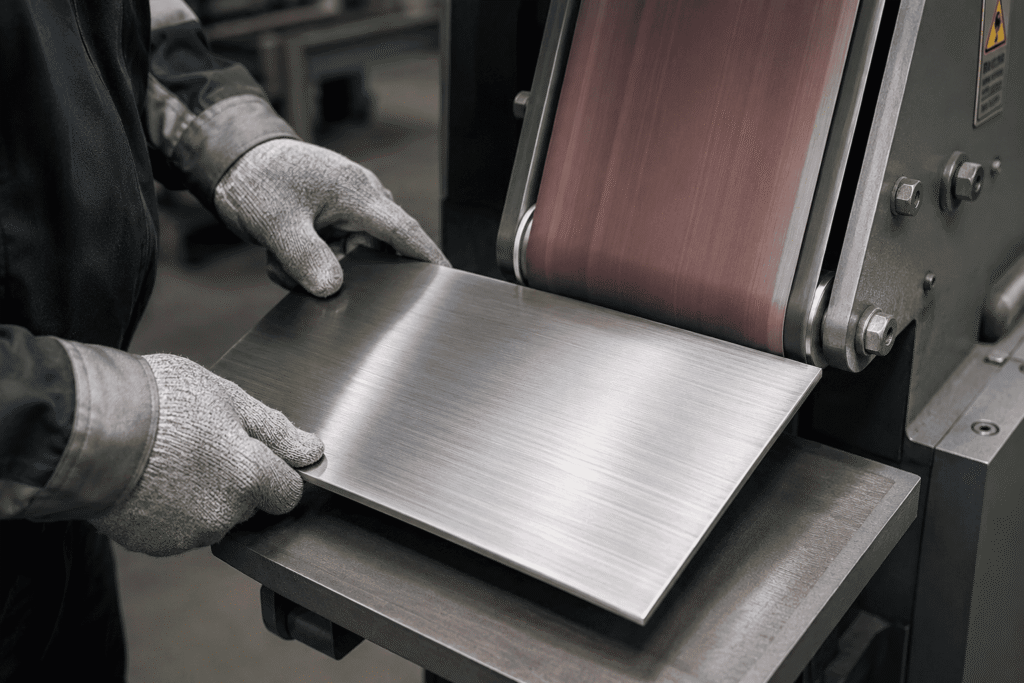
Abrasive belt brushing is the most common method used in sheet metal factories. It uses abrasive belts to grind and texture the metal surface in a controlled direction.
This method is suitable for:
Flat sheet metal parts.
Large panels.
Cabinet doors.
Equipment covers.
Stainless steel sheets.
Aluminum panels.
Abrasive belt brushing offers high efficiency and good consistency, especially for batch production. Different grit sizes can be selected depending on the desired surface texture.
2. Manual Brushing
Manual brushing is performed using handheld brushing machines, angle grinders, sanding pads, nylon wheels or abrasive cloths. It is often used for small batches, irregular parts, welded areas and local repair work.
Manual brushing is flexible, but it depends heavily on worker skill. If the pressure, speed or direction is not controlled well, defects such as uneven grain, stop marks, overlap marks or inconsistent brightness may appear.
For high-volume visible parts, machine brushing is usually preferred.
3. Nylon Wheel Brushing
Nylon wheel brushing produces a softer and finer surface texture. It is suitable for satin finish and fine decorative brushing.
This method is often used for high-quality sheet metal parts, such as medical equipment housings, electronic enclosures, control panels and premium stainless steel covers.
The main advantage of nylon wheel brushing is that it creates a smooth and refined appearance without deep grinding marks.
4. Wire Brush Brushing
Wire brush brushing can create a more obvious and rougher texture. It is suitable for some industrial-style products or decorative effects.
However, for thin sheet metal parts, wire brushing must be handled carefully. Excessive pressure may cause deep scratches, deformation or uneven surface marks.
5. Wet Brushing or Oil Brushing
Wet brushing, also known as oil brushing in some workshops, uses oil, water or coolant during the brushing process. This helps reduce heat, dust and surface burning. It can also create a finer and smoother brushed finish.
Wet brushing is commonly used for stainless steel decorative sheets, elevator panels, kitchen equipment and products with higher surface requirements.
Compared with dry brushing, wet brushing usually provides a better surface effect, but the cost and process requirements are also higher.
Typical Sheet Metal Brushing Process
The brushing process may vary depending on the product structure, material and surface requirements. A typical sheet metal brushing workflow includes:
Material preparation → Cutting → Bending → Welding → Weld grinding → Deburring → Surface cleaning → Rough grinding → Fine brushing → Cleaning → Inspection → Protective film application → Packaging
For stainless steel parts, protective film is often applied after brushing to prevent scratches during transportation and assembly.
For aluminum parts, brushing is often followed by anodizing to improve durability and corrosion resistance.
For welded sheet metal assemblies, weld grinding is very important before brushing. If the weld area is not properly leveled, the final brushed surface may show bright spots, dark marks, distortion or visible weld traces.
How to Choose the Right Grit for Brushed Sheet Metal
Abrasive grit size directly affects the final surface texture. A lower grit number means a coarser abrasive and deeper grain. A higher grit number means a finer abrasive and smoother texture.
Common choices include:
80# to 120#: Coarse brushing, suitable for industrial appearance or rough pre-grinding.
180# to 240#: Medium brushing, widely used for machine enclosures, cabinets, stainless steel panels and equipment covers.
320# to 400#: Fine brushing, suitable for higher-end visible parts.
Above 400#: Very fine finish, often used for premium decorative panels, electronic products and refined aluminum parts.
In real production, grit selection should not be based only on numbers. The final result also depends on material hardness, original sheet surface, brushing equipment, abrasive condition, operator skill and subsequent surface treatment.
For products with strict appearance requirements, sample confirmation is strongly recommended before mass production.
Important Quality Control Points
1. Confirm the Brushing Direction
Brushing direction is one of the most important details in sheet metal finishing. For cabinets, panels and machine covers, all visible surfaces should have a consistent grain direction.
The drawing should clearly indicate requirements such as:
Vertical brushing on visible surfaces.
Horizontal brushing on front panels.
Same grain direction for all exposed parts.
Without clear instructions, the final assembled product may show inconsistent surface patterns.
2. Control Weld Grinding Quality
For welded sheet metal parts, weld grinding must be smooth and even before brushing. If the weld is over-ground, the surface may become uneven. If the weld is not ground enough, the weld mark may remain visible after brushing.
This is especially important for stainless steel parts, because the weld zone and base material may show different brightness after brushing.
3. Avoid Color Difference and Cloud Marks
Color difference and cloud marks may be caused by inconsistent pressure, worn abrasive belts, uneven material surfaces, oil contamination or different material batches.
To reduce these problems, the factory should keep processing parameters stable and use consistent abrasives for the same production batch.
4. Prevent Deformation of Thin Sheet Metal
Thin sheet metal parts can deform during brushing if the pressure is too high or heat is concentrated in one area. Proper clamping, suitable abrasive selection and controlled feeding speed are important for maintaining flatness.
5. Protect the Surface After Brushing
Although brushed surfaces can hide minor scratches better than mirror-polished surfaces, they are still vulnerable to damage. After brushing, protective film and proper packaging should be used to prevent scratches during handling, transportation and assembly.
Common Applications of Brushed Sheet Metal
Brushed sheet metal is widely used in both industrial and decorative products. Common applications include:
Machine enclosures.
Electrical cabinets.
Control boxes.
Server cabinets.
Automation equipment housings.
Medical device covers.
Food machinery housings.
Kitchen equipment.
Elevator panels.
Stainless steel doors.
Display racks.
Signage and nameplates.
Aluminum control panels.
Architectural decoration panels.
For industrial equipment, a brushed finish gives the product a cleaner and more professional appearance. For decorative applications, it enhances the metallic texture and creates a modern visual effect.
How to Choose a Sheet Metal Brushing Manufacturer
When choosing a sheet metal fabrication supplier for brushed metal parts, price should not be the only consideration. Surface finishing quality depends on equipment, experience, process control and inspection standards.
A reliable manufacturer should be able to:
Understand different brushing finishes and applications.
Recommend suitable materials and surface treatments.
Control grain direction and surface consistency.
Handle weld grinding and deburring properly.
Provide samples before mass production.
Apply protective film and safe packaging.
Support custom sheet metal fabrication based on drawings.
For visible metal parts, sample approval is especially important. It helps confirm the grain direction, texture, brightness and overall appearance before batch production.
Conclusion
Sheet metal brushing finish is a practical and attractive surface treatment for stainless steel, aluminum, copper and other metal materials. Common brushed finishes include hairline finish, No.4 finish, satin finish, random brushing, circular brushing, cross brushing and wave brushing.
For stainless steel sheet metal parts, hairline finish and No.4 finish are among the most commonly used options. For aluminum panels, brushing is often combined with anodizing to achieve both appearance and durability. For decorative products, random brushing, circular brushing or wave brushing can provide a more unique visual effect.
When designing brushed sheet metal parts, it is important to specify the material, brushing type, grain direction, grit requirement, visible surfaces, welding treatment, protective film and any post-treatment requirements. Clear communication between the customer and the sheet metal manufacturer can greatly improve product quality and reduce production risks.
If you need custom brushed stainless steel parts, brushed aluminum panels, machine enclosures, electrical cabinets or precision sheet metal fabrication, choosing an experienced sheet metal factory can help ensure stable quality, consistent appearance and reliable delivery.
FAQ: Sheet Metal Brushing Finish
1. What is the difference between brushing and polishing?
Brushing creates visible grain lines on the metal surface and usually produces a matte or semi-matte appearance. Polishing makes the surface smoother and brighter, and it can even create a mirror-like effect. In simple terms, brushing focuses on texture, while polishing focuses on brightness and reflectivity.
2. Is brushed stainless steel rust-proof?
Brushed stainless steel has good corrosion resistance, but it is not completely rust-proof in all environments. If the surface is contaminated by iron particles, exposed to strong chemicals or used in salty and humid environments, rust spots may still appear. For demanding applications, passivation, anti-fingerprint coating or proper cleaning may be recommended.
3. Can aluminum sheet metal be brushed?
Yes. Aluminum sheet metal is very suitable for brushing. A common process is brushing followed by anodizing. This keeps the brushed texture visible while improving surface hardness, corrosion resistance and color options.
4. Does brushed sheet metal scratch easily?
A brushed surface can hide small scratches better than a mirror-polished surface, but it can still be scratched. Protective film, careful handling and proper packaging are important after brushing.
5. What information should be provided for a brushed sheet metal quotation?
For an accurate quotation, it is best to provide drawings, material grade, thickness, visible surface requirements, brushing direction, grit requirement, surface sample, post-treatment requirements and order quantity. For appearance-critical parts, sample confirmation before mass production is recommended.