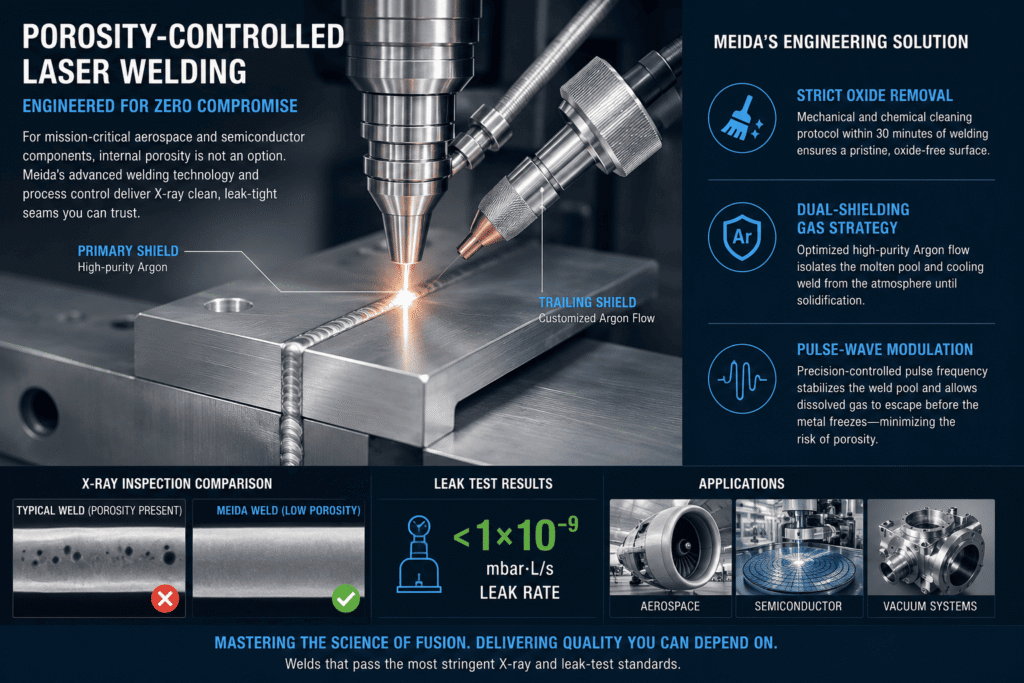
In aerospace and semiconductor manufacturing, a weld that looks flawless on the surface may still conceal critical internal defects. Microscopic gas pockets—known as porosity—can reduce fatigue life, compromise structural integrity, and create leak paths in high-vacuum assemblies.
The Technical Challenge
Aluminum reacts rapidly with oxygen, forming a persistent aluminum oxide layer (Al₂O₃). This surface layer can retain moisture and other contaminants. During laser welding, hydrogen generated from these contaminants may dissolve into the molten metal. As the weld pool rapidly solidifies, the hydrogen can become trapped, forming internal pores.
Meida’s Engineering Solution
Strict Oxide Removal
We use a controlled mechanical and chemical cleaning process immediately before welding. Welding is completed within 30 minutes of surface preparation, minimizing oxide regrowth and recontamination.
Dual-Shielding Gas Strategy
High-purity argon is delivered through an optimized primary shield and a customized trailing shield. This protects both the molten weld pool and the cooling seam from atmospheric oxygen and moisture until solidification is complete.
Pulse-Wave Modulation
Our engineers precisely tune laser pulse frequency, duration, and energy distribution to stabilize the weld pool and manage the solidification rate. This creates additional time for dissolved gas to escape before it can become trapped within the seam.
Verified Weld Integrity
By controlling surface preparation, atmospheric shielding, and weld-pool dynamics, Meida produces aluminum welds with exceptionally low porosity—engineered to meet demanding radiographic inspection and leak-testing requirements for aerospace and semiconductor applications.
Technical wording note: Unless every seam is validated against a defined acceptance threshold, “exceptionally low porosity” or “porosity-free within inspection limits” is more defensible than an absolute “zero-porosity” claim.