
As electric vehicle charging stations advance toward ultra-fast charging at 350kW and above, the electrical and thermal demands placed on internal power-distribution components are reaching unprecedented levels.
At these power levels, even a minor dimensional error or poor electrical connection can create excessive resistance, localized heating, and long-term reliability risks. As a result, precision-engineered copper busbars for EV charging systems are becoming increasingly important.
Why EV Charging Systems Are Moving from Cables to Copper Busbars
Traditional cable assemblies are gradually being replaced by integrated copper busbars in high-power EV charging equipment.
Compared with conventional wiring, copper busbars can provide:
- Higher current-carrying capacity
- Lower electrical resistance
- More compact power-module layouts
- Improved heat dissipation and thermal stability
- Faster and more consistent assembly
- Better mechanical reliability
However, these advantages depend heavily on manufacturing accuracy.
Poor hole alignment, inconsistent bending angles, or uncontrolled material spring-back can prevent full contact between stacked busbars and terminals. This increases contact resistance and may create dangerous electrical “hot spots” inside the charging system.
Meida Case Study: Improving an EV Charger Power Module
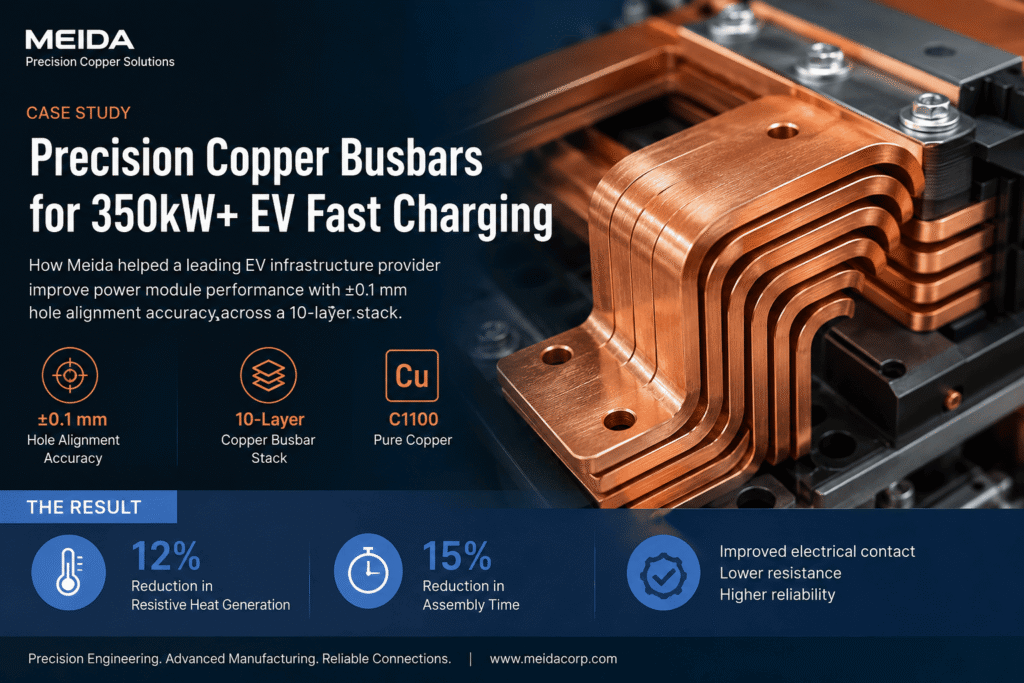
Meida recently supported a leading EV charging infrastructure provider in optimizing the copper busbar assembly used in its high-power charging module.
The Challenge: Inconsistent Hole Alignment
The customer’s original copper busbars showed inconsistent mounting-hole alignment after bending.
When multiple busbars were assembled into a 10-layer stack, even small dimensional deviations accumulated across the layers. This made bolt insertion more difficult, increased assembly time, and reduced the consistency of electrical contact at the connection points.
Poor contact can lead to higher resistance, additional heat generation, and reduced long-term system reliability.
The Solution: Spring-Back Compensation for C1100 Copper
Meida manufactured the components using C1100 pure copper, a material widely selected for high-current applications because of its excellent electrical conductivity.
During CNC bending, our engineering team applied a customized spring-back compensation logic based on the busbar geometry, material thickness, bending radius, and copper mechanical properties.
Rather than relying only on nominal bend angles, the CNC bending process was adjusted to compensate for the natural elastic recovery of the copper after forming.
This allowed us to achieve:
Mounting-hole alignment accuracy of ±0.1 mm across the complete 10-layer copper busbar stack.
The improved dimensional consistency enabled the layers to align correctly without extensive manual adjustment during assembly.
Measurable Results
After implementing the optimized copper busbar design and manufacturing process, the customer achieved:
- 12% reduction in resistive heat generation
- 15% reduction in assembly time
- More consistent electrical contact between layers
- Easier bolt insertion and component installation
- Improved repeatability during production
- Lower risk of localized overheating
These improvements helped the customer increase both the thermal performance and manufacturability of its EV charging power module.
Why Busbar Precision Matters in Ultra-Fast EV Charging
In a low-power electrical system, a small dimensional variation may cause only a minor inconvenience. In a 350kW+ EV charging station, the same variation can affect current distribution, contact resistance, operating temperature, and equipment reliability.
Critical copper busbar characteristics include:
- Hole-position accuracy
- Bend-angle consistency
- Surface flatness
- Contact-area quality
- Material conductivity
- Plating thickness and uniformity
- Dimensional consistency across stacked components
Controlling these factors requires more than standard sheet-metal fabrication. It requires an understanding of both mechanical forming behavior and high-current electrical performance.
Precision Copper Busbar Manufacturing for EV Charging Applications
Meida provides custom copper busbar manufacturing for high-current applications, including:
- Ultra-fast EV charging stations
- EV charger power modules
- Battery energy storage systems
- Power conversion systems
- Inverters and rectifiers
- Renewable-energy equipment
- Industrial power-distribution systems
Our capabilities include CNC punching, precision bending, spring-back compensation, surface finishing, plating, insulation, and dimensional inspection.
Conclusion
In the green-energy transition, the difference between a reliable high-power system and a potential failure can come down to the precision of a single copper component.
For ultra-fast EV charging applications, accurate copper busbar fabrication helps reduce electrical resistance, control heat generation, simplify assembly, and improve long-term system reliability.
By combining C1100 copper, controlled CNC bending, and application-specific spring-back compensation, Meida delivers precision busbars engineered for the demanding electrical and thermal conditions of next-generation EV charging infrastructure.
FAQ :
What type of copper is used for EV charging busbars?
C1100 pure copper is commonly used for EV charging busbars because it provides high electrical conductivity, good thermal performance, and reliable formability for precision bending.
Why is hole alignment important in stacked copper busbars?
Accurate hole alignment ensures proper mechanical fastening and consistent electrical contact. Misaligned holes can create uneven pressure, increase contact resistance, slow assembly, and contribute to localized overheating.
What is spring-back compensation in busbar bending?
Spring-back compensation is a CNC bending method that accounts for the small amount of elastic recovery that occurs after copper is formed. By adjusting the programmed bend angle, manufacturers can achieve more accurate final dimensions.
Can copper busbars improve EV charger assembly efficiency?
Yes. Properly designed and accurately manufactured busbars can reduce wiring complexity, simplify installation, improve repeatability, and shorten the assembly time of EV charger power modules.