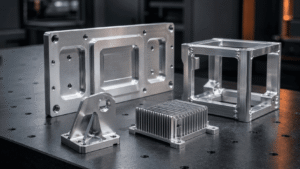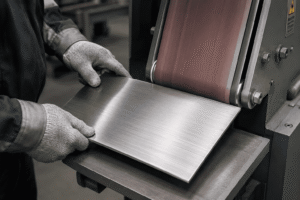
Aluminum is one of the most widely used materials in modern manufacturing due to its lightweight, corrosion resistance, and excellent strength-to-weight ratio.
However, not all aluminum alloys perform the same.
Two of the most commonly used aluminum grades in precision fabrication are 5052 aluminum and 6061 aluminum.
Although they may look similar, their mechanical properties, fabrication behavior, and ideal applications are quite different.
Choosing the wrong alloy can lead to unnecessary cost, difficult manufacturing processes, or reduced product performance.
At Meida Sheet Metal, we frequently help engineers select the right aluminum alloy based on strength requirements, fabrication methods, surface treatment, and production volume.
This guide explains the key differences between 5052 and 6061 aluminum.
1. Overview of 5052 Aluminum and 6061 Aluminum
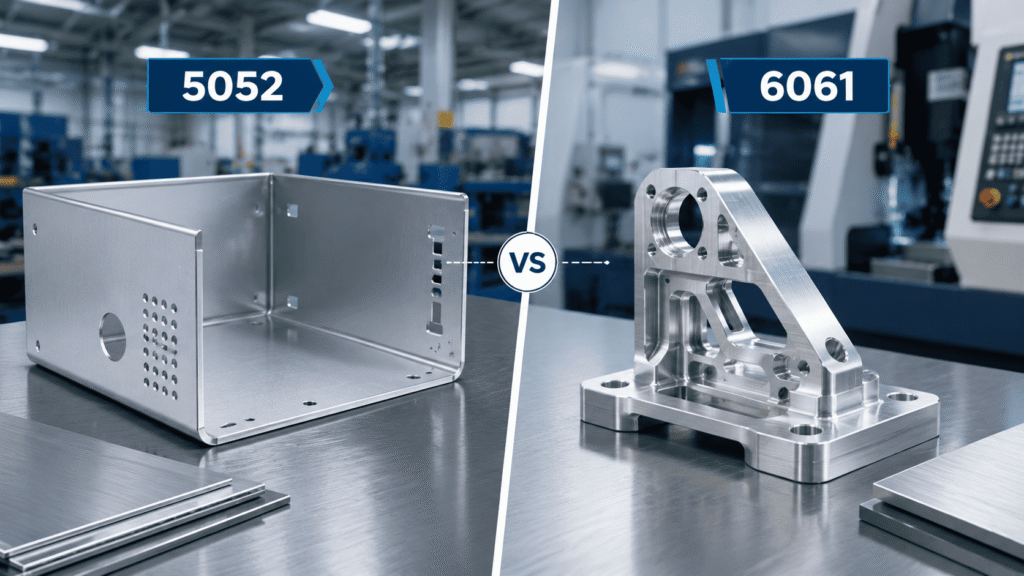
5052 Aluminum: The Sheet Metal Fabrication Specialist
5052 aluminum belongs to the 5xxx series aluminum alloys, with magnesium as the primary alloying element.
It is known for:
- Excellent corrosion resistance
- Outstanding weldability
- High formability
- Good fatigue strength
Because of its excellent bending performance, 5052 aluminum is one of the most popular materials for sheet metal fabrication.
Typical applications include:
- Electrical enclosures
- Control cabinets
- Marine components
- Pressure vessels
- Covers and brackets
- Industrial equipment panels
6061 Aluminum: The Structural Strength Choice
6061 aluminum belongs to the 6xxx series aluminum alloys, with magnesium and silicon as the main alloying elements.
It is one of the most versatile aluminum alloys because it provides:
- Higher strength
- Better machining performance
- Good surface finishing capability
- Excellent structural performance
Typical applications include:
- Machine frames
- Structural brackets
- Aerospace components
- Robotic equipment
- Precision machined parts
- Heat sinks
2. Chemical Composition Comparison
| Element | 5052 Aluminum | 6061 Aluminum |
|---|---|---|
| Aluminum | Balance | Balance |
| Magnesium | Higher | Moderate |
| Silicon | Very low | Higher |
| Copper | Very low | Higher |
| Primary Benefit | Formability & corrosion resistance | Strength & machinability |
The difference in alloy composition creates significant differences in manufacturing performance.
3. Mechanical Properties Comparison
| Property | 5052-H32 | 6061-T6 |
|---|---|---|
| Tensile Strength | ~210 MPa | ~310 MPa |
| Yield Strength | ~160 MPa | ~276 MPa |
| Hardness | Medium | Higher |
| Density | 2.68 g/cm³ | 2.70 g/cm³ |
| Strength-to-weight ratio | Good | Excellent |
6061-T6 is significantly stronger than 5052-H32.
For load-bearing structures, frames, and mechanical components, 6061 is usually the better choice.
However, higher strength also means lower formability.
4. Fabrication Performance Comparison
Bending & Forming
Winner: 5052 Aluminum
5052 has excellent ductility, making it ideal for:
- CNC bending
- Sheet metal forming
- Complex shapes
- Thin-wall enclosures
It can be bent without cracking and maintains good dimensional stability.
6061-T6 is much harder and more brittle.
During bending, it is more likely to experience:
- Cracking
- Spring-back
- Surface damage
For sheet metal parts with multiple bends, 5052 is usually preferred.
Welding Performance
Winner: 5052 Aluminum
5052 has excellent welding characteristics.
Common welding methods:
- TIG welding
- MIG welding
- Laser welding
Advantages:
- Lower risk of cracking
- Stable weld appearance
- Better corrosion resistance after welding
6061 can also be welded, but welding reduces the T6 temper strength in the heat-affected zone.
Additional heat treatment may be required for critical applications.
Machining Performance
Winner: 6061 Aluminum
6061 is easier to machine because of its hardness and chip-breaking characteristics.
It performs well in:
- CNC milling
- CNC turning
- Drilling
- Precision machining
5052 is softer and tends to create:
- Sticky chips
- Burrs
- More difficult machining conditions
5. Corrosion Resistance Comparison
Slight Advantage: 5052 Aluminum
5052 contains higher magnesium content, providing excellent resistance against:
- Saltwater environments
- Humidity
- Industrial corrosion
It is widely used in marine and outdoor applications.
6061 also has good corrosion resistance but may require surface protection for harsh environments.
Common finishes include:
- Anodizing
- Powder coating
- Chemical conversion coating
6. Surface Finishing Comparison
Both materials support various finishing processes.
5052 Aluminum
Common finishes:
- Powder coating
- Brushed finish
- Anodizing
- Painting
Advantages:
- Smooth appearance
- Good cosmetic quality
6061 Aluminum
Common finishes:
- Clear anodizing
- Hard anodizing
- Sand blasting
- CNC machined finish
Advantages:
- Better appearance after machining
- More suitable for precision components
7. Cost Comparison
Generally:
5052 aluminum: Lower material cost + lower fabrication difficulty
6061 aluminum: Higher material cost + higher machining cost
However, the total project cost depends on:
- Part geometry
- Manufacturing process
- Required tolerance
- Surface treatment
- Production volume
A cheaper material is not always the lowest-cost solution.
For example:
Using 6061 for a bent enclosure may increase manufacturing cost because of forming difficulties.
Using 5052 for a structural frame may require additional reinforcement.
8. 5052 vs 6061 Aluminum: Application Guide
| Application | Recommended Alloy |
|---|---|
| Sheet metal enclosure | 5052 |
| Electrical cabinet | 5052 |
| Outdoor equipment housing | 5052 |
| Machine frame | 6061 |
| CNC machined parts | 6061 |
| Structural bracket | 6061 |
| Heat sink | 6061 |
| Complex bent panels | 5052 |
| High-strength components | 6061 |
9. How Engineers Choose Between 5052 and 6061 Aluminum
The correct material depends on several factors:
1. Manufacturing Process
If the part requires:
- Laser cutting
- CNC bending
- Welding
→ 5052 is usually preferred.
If the part requires:
- CNC machining
- High precision
- Structural strength
→ 6061 is usually preferred.
2. Mechanical Requirements
Choose 6061 when:
- High stiffness is required
- Loads are significant
- Weight reduction is important
Choose 5052 when:
- Formability matters
- Corrosion resistance is critical
- The part is fabricated from sheet metal
3. Final Product Environment
Outdoor, marine, or humid environments often favor 5052.
Precision industrial equipment often benefits from 6061.
10. Meida Sheet Metal: Aluminum Fabrication Expertise
At Meida Sheet Metal, we work with a wide range of aluminum materials, including:
- 5052-H32 aluminum sheet
- 6061-T6 aluminum plate
- Aluminum extrusions
- Custom aluminum assemblies
Our manufacturing capabilities include:
- Fiber laser cutting
- CNC bending
- TIG/MIG welding
- Laser welding
- CNC machining
- Surface finishing
- Assembly
From prototype development to volume production, our engineering team helps customers select the right aluminum alloy for performance, manufacturability, and cost optimization.
The best material is not always the strongest one — it is the one that best matches the design requirements and manufacturing process.
Conclusion
5052 and 6061 aluminum are both excellent materials, but they serve different purposes.
Choose 5052 aluminum when you need:
✔ Excellent bending performance
✔ Superior corrosion resistance
✔ Reliable welding
✔ Sheet metal fabrication capability
Choose 6061 aluminum when you need:
✔ Higher strength
✔ Better machining performance
✔ Structural rigidity
✔ Precision components
Understanding the difference between aluminum alloys before production can significantly improve product quality, reduce cost, and avoid manufacturing problems.